Build at the Speed of Intelligence

Transform your SDLC from fragmented handoffs into a governed, agentic delivery model where AI helps plan, design, code, review, test, secure, release, and improve software continuously.

Accelerate delivery

Reduce manual effort across discovery, documentation, coding, testing, and release readiness.

Engineer quality earlier

Generate tests, inspect code, review dependencies, and validate production readiness before release.

Govern with confidence

Use human approvals, audit trails, policy gates, rollback paths, and responsible AI controls.

Scale adoption safely

Create delivery standards so prototypes can mature into governed enterprise systems.

From traditional SDLC to AI-Native Engineering.

Traditional SDLC moves work through linear gates. AI-native engineering redesigns the model around agentic workflows, structured repository context, human oversight, and continuous feedback.

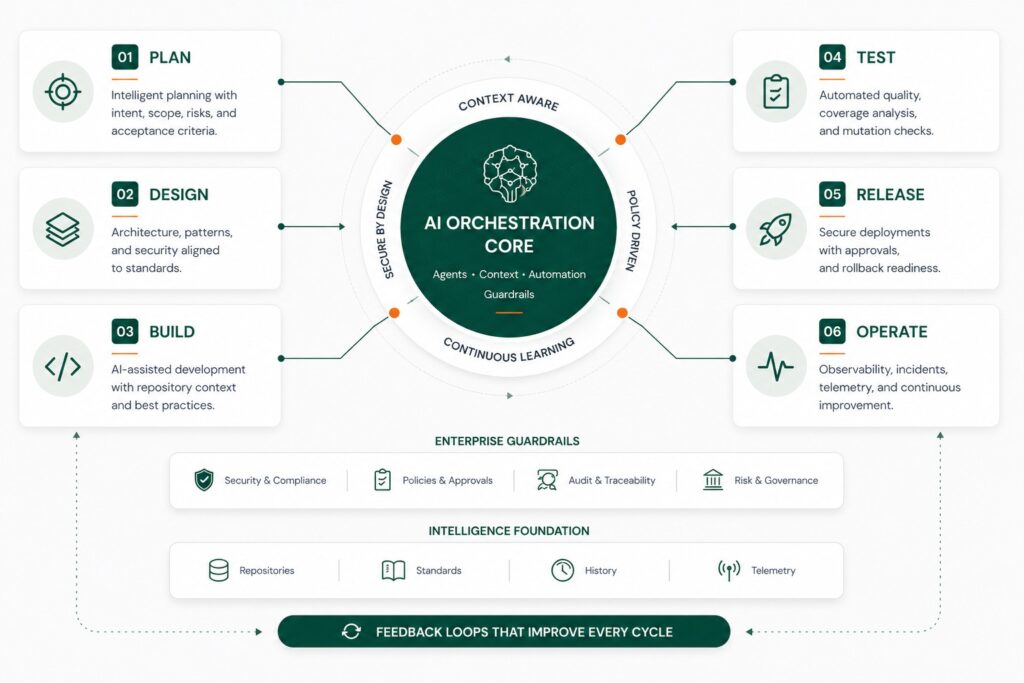
AI-Native Engineering does not replace the SDLC. It surrounds every phase with context, automation, governance, and feedback so delivery becomes faster, safer, and continually improves.
AI Across the Complete Software Lifecycle.

Each SDLC stage gets a practical intelligence layer: better inputs, faster execution, stronger validation, safer releases, and clearer decision points.

Plan & Prioritize

Convert business goals, backlog signals, and stakeholder input into epics, user stories, and acceptance criteria.

Design & Architect

Generate architecture options, ADRs, integration flows, trade-off analysis, and NFR mappings.

Develop & Review

Accelerate implementation, refactoring, repository-aware code review, and pull request support.

Test & Validate

Create test cases, BDD scenarios, traceability matrices, coverage insights, and mutation analysis.

Secure & Govern

Embed threat modeling, dependency review, secret scanning, approval gates, and auditability.

Deploy & Operate

Connect telemetry, release signals, incidents, and reliability insights back into future planning.

From Linear Delivery to An Intelligent Engineering System.

AI-Native Engineering does not replace the SDLC. It surrounds every phase with context, automation, governance, and feedback so delivery becomes faster, safer, and continually improves.

Executive principle

The shift is not “to add a chatbot to the IDE.” The shift is a governed operating model where requirements, code, tests, reviews, incidents, and decisions compound into reusable engineering intelligence.

Context before automation

Agents are only useful when grounded in repository knowledge, standards, history, telemetry, and business intent.

Control before scale

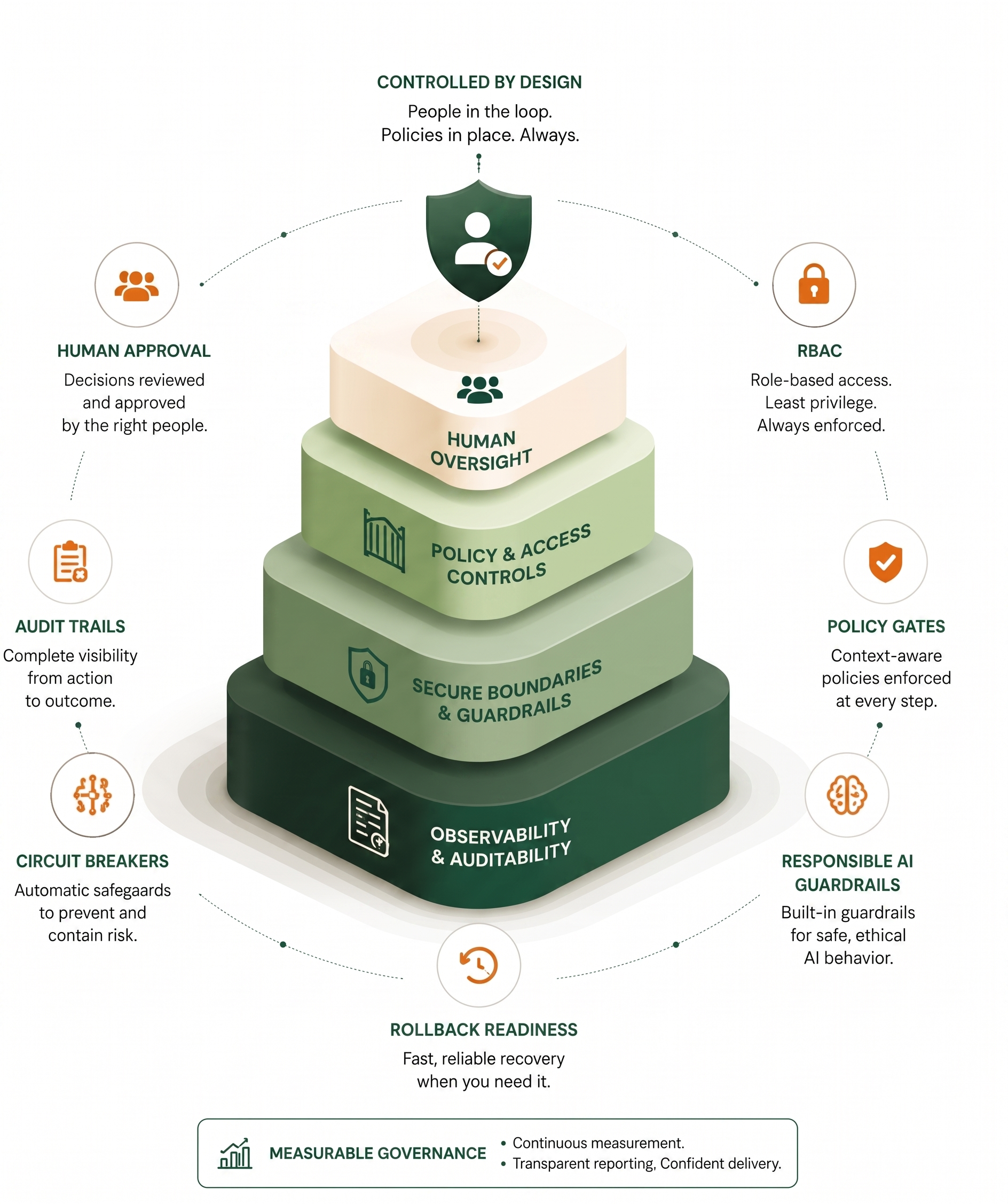
Policy gates, approvals, auditability, secure boundaries, and rollback paths make AI adoption enterprise-safe.

Learning before optimisation

Engineering signals from quality, release, operations, and incidents are used to improve the next delivery cycle.

Speed

Reduced delivery friction

Quality

Earlier defect detection

Risk

Controlled AI execution

Learning

Reusable engineering memory

Reference Architecture Overview

AI-Native SDLC Operating Model

SDLC Flow

Plan

Intent, scope, risk, acceptance criteria

Design

Architecture, patterns, security posture

Build

Code generation with repository context

Test

Quality, coverage, regression, mutation checks

Release

Approvals, deployment, rollback readiness

Operate

Telemetry, incidents, learning loops

AI Spine

Shared Context Layer

Connect business intent, repositories, standards, architecture decisions, and telemetry.

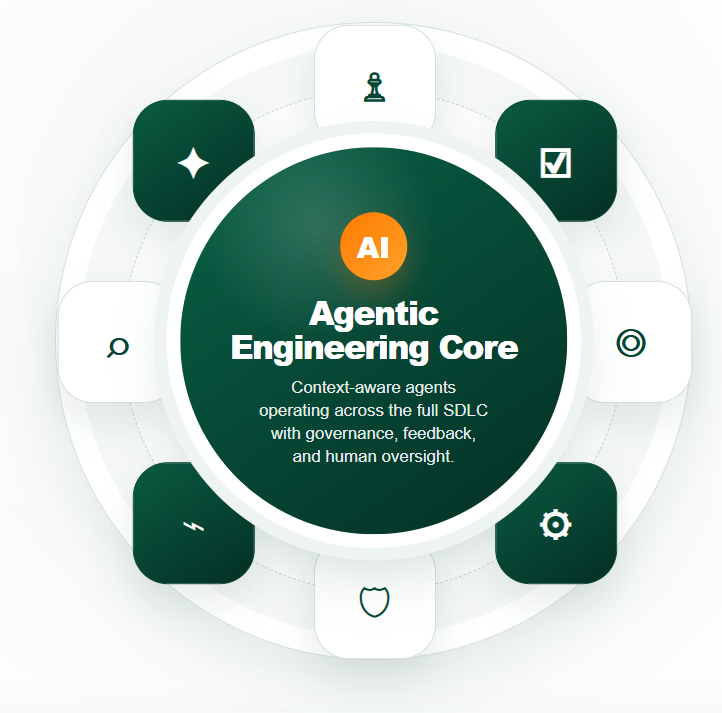
Agentic Engineering Core

Coordinate planner, architect, coder, reviewer, tester, security, and release agents.

Governance Control Layer

Apply approval gates, secure boundaries, audit trails, risk controls, and rollback logic.

Continuous Learning Layer

Feed defects, review trends, cycle time, incidents, and telemetry into future work.

Controls

Security

Connect business intent, repositories, standards, architecture decisions, and telemetry.

Agentic Engineering Core

Coordinate planner, architect, coder, reviewer, tester, security, and release agents.

Governance Control Layer

Apply approval gates, secure boundaries, audit trails, risk controls, and rollback logic.

Continuous Learning Layer

Feed defects, review patterns, cycle time, incidents, and telemetry into future work.

Knowledge

Repository Context

Codebase, branches, pull requests, documentation, and patterns.

Architecture Memory

Design decisions, constraints, integrations, and standards.

Delivery Evidence

Test results, approvals, reviews, releases, and audit records.

Operational Signals

Telemetry, incidents, defects, reliability trends, and user feedback.

The operating layer for agentic software delivery

This Combines platform, stack, use cases, and transformation into one capability layer: agentic workflows, repository context, integrations, quality gates, governance, knowledge, and continuous improvement.

Agentic Workflow Orchestration

Coordinate planner, architect, coder, reviewer, tester, security agents, and release agents with defined responsibilities, handoffs, and escalation paths.


Full Lifecycle Integration

Connect requirements, architecture, implementation, testing, release, and operations through shared artifact flow.

Repository Context & Instructions

Use repository instructions, structured context, reusable prompt patterns, and scoped task memory to reduce drift.

Enterprise Toolchain Integration

Source control, work management, CI/CD, security scanning, observability, service management, collaboration, and cloud.

AI-Assisted Quality Engineering

Generate and maintain unit, integration, regression, BDD, and mutation testing assets with traceability.

Continuous Engineering Feedback

Use quality signals, cycle time, review patterns, defects, incidents, and telemetry to improve delivery.

Governance, Safety & Compliance

Apply approval workflows, policy gates, secure data boundaries, rollback controls, audit trails, and AI guardrails.

SDLC Knowledge Graph

A governed knowledge layer across requirements, code, tests, documents, telemetry, incidents, and architecture decisions.

From Experimentation to Mission-Critical Software.

Tier-appropriate delivery standards let prototypes move safely into supported environments when they prove value making experimentation visible, classified, registered, and governed without slowing innovation.

Eight Standard Dimensions

The foundation of quality, reliability, and scalable delivery.

Documentation and tests serve double duty

Readable by humans, consumable by AI agents, and durable enough to support repeatable delivery.

Graduation Path

Clear progression. Stronger systems. Better outcomes.

Experiment

Fast exploration with low friction, lightweight documentation, and basic safety boundaries.

1
Team Utility

Shared usage with ownership, repeatable tests, review expectations, and basic support rules.

2
Business-Critical Application

Formal controls, quality gates, data handling rules, monitoring, and release discipline.

3
Mission-Critical Application

High assurance, operational resilience, auditability, rollback readiness, and stronger governance.

4

Built for control, not unchecked automation.

AI-Native Software Delivery works best when acceleration is paired with review discipline, secure boundaries, clear ownership, inspectable agent behavior, and measurable governance.
Business outcomes leaders can measure.

AI-Native Engineering becomes valuable when it creates visible movement in speed, productivity, quality, traceability, risk, and governance.
EXECUTIVE LENS

Move from AI adoption to delivery excellence

The goal is not more AI usage—it’s measurable improvement in how software is planned, built, tested, released, governed, and improved.

6

Outcome areas

18+

Leadership signals

1

Governed operating view

Outcome
Business movement
What leaders track
Faster Delivery Cycles
Reduce repetitive documentation, coding, testing, and release preparation effort.
Lead time Cycle time Release frequency
Higher Engineering Productivity
Help teams focus on design choices, quality, security, and business logic.
Throughput Review time Rework effort
Stronger Test Coverage
Generate broader scenarios and identify weak tests using coverage and mutation signals.
Coverage depth Mutation score Escaped defects
Improved Traceability
Connect requirements, code, tests, releases, and incidents across one delivery thread.
Requirement linkage Release evidence Audit completeness
Reduced Operational Risk
Use telemetry and incident feedback to improve future releases before issues repeat.
MTTR Incident recurrence Change failure rate
Stronger Governance
Make AI-assisted delivery auditable, reviewable, and aligned with enterprise controls.
Policy adherence Approval evidence Exception trends

Designed to work with your existing stack.

AI-Native Engineering should integrate into how your teams already plan, build, test, secure, deploy, observe, and collaborate.

Planning

Development

Testing

DevSecOps

Cloud & AI

Observability

Collaboration

Infrastructure

Prove it with real teams, then scale the operating model

One adoption journey: assess, pilot, codify, scale, and improve.

Readiness Assessment

Identify SDLC bottlenecks, AI opportunities, governance gaps, and quick-win automation areas.

Focused Pilot

Run a practical pilot with real teams across one application, one workflow, or one lifecycle stage.

AI Engineering Playbook

Reusable prompts, repository instructions, agent roles, review gates, context files, and standards.

Enterprise Rollout

Scale adoption through training, coaching, metrics, governance, and quarterly learning loops.

We build it with you, not around you.

The engagement proves the model in your context: real systems, real teams, real constraints, and clear runbooks for production, support, and incident handling.
The end state is not a demo. It is a repeatable way of building software where agentic workflows, human judgment, and enterprise governance reinforce each other.

Move beyond traditional pipelines.

Build a connected, governed, AI-Native delivery model that improves delivery speed, engineering quality, operational resilience, and enterprise control.

Start Your AI-Native SDLC Pilot

Consultation For Services

Get Your Training Details

Get Your Strategy Assessment